Before the Logo: A Short History of the Maker’s Mark
The history of the maker’s mark traces how names and symbols on crafted objects connected them to people, workshops and places across changing forms of production.
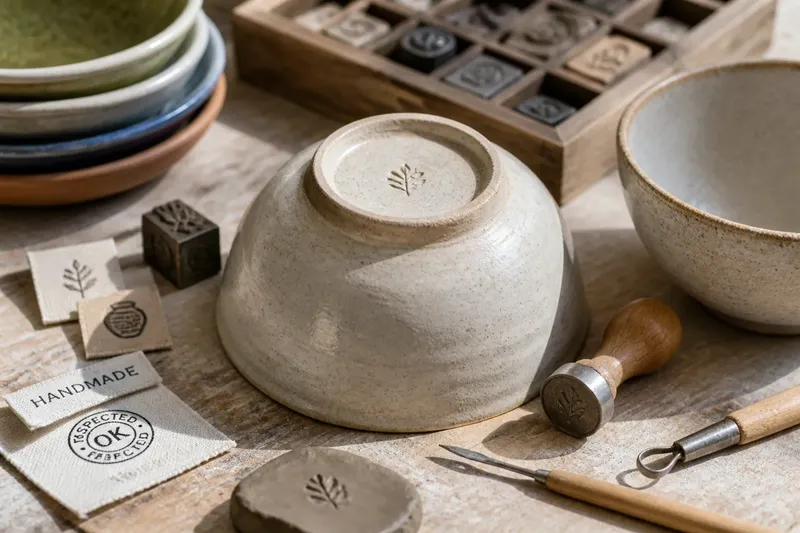
A potter turns a bowl over before it goes on the shelf and presses a small mark into its foot. The history of the maker’s mark begins with this practical gesture: placing a sign on an object so that someone might connect it to a person, workshop or place. Across different crafts, those connections took varied forms; there was no single route from an individual signature to the modern brand.
A maker’s mark is not simply an early logo. It may identify an individual, a workshop, a place of origin or a standard recognised within a particular trade. Sometimes its purpose is uncertain. To understand a mark, consider its material, position and context rather than treating the symbol as a complete record of who made an object.
Maker’s marks connected objects to their sources
A maker’s mark is a sign placed on or attached to a crafted object. It might be a stamped name, an incised symbol, a painted initial, a woven label or a seal. The mark can be made as part of the object or added afterwards.
Some marks point to a person. Others identify a workshop where several people contributed, or refer to a town or region associated with a trade. A mark might also indicate a material, category or inspection. These functions can overlap, so a single symbol does not necessarily tell us who shaped every part.
Material and method influence what a mark can communicate. A stamp can leave an impression in clay; a tool can strike a sign into metal; a label can be sewn into a garment. A carved wooden object might carry a discreet signature underneath, away from its visible design. Position and technique provide context, but neither settles the mark’s meaning on its own.
Read the mark alongside the object, not in isolation.
Early marks served different purposes in different trades
There is no simple, universal account of why craftspeople began marking goods. Objects and marks survive unevenly, and a sign’s meaning depends on its place, period and trade. A careful account therefore avoids treating all marks as signatures or assuming that the same practice developed everywhere in the same way.
In some contexts, a mark could help keep an object connected to its source after it left the maker’s immediate surroundings. It might distinguish one workshop’s goods from another’s or help buyers recognise a familiar supplier. In other settings, marks formed part of systems for identifying material, recording responsibility or indicating that an item had been checked according to local rules. The details varied, and a mark that appears similar in two places may not have carried the same meaning.
These practical uses did not always express artistic identity. A sign might help with recognition or accountability without claiming that one named person had made the whole object. It could also be difficult for a later owner to interpret once the conventions of its original setting were no longer familiar.
Workshop marks did not always name one maker
As production involved more than one pair of hands, a mark could refer to a workshop rather than an individual craftsman. A business might continue using a founder’s name or symbol while different workers performed different tasks. In that case, the mark connected an object to a source of production, not necessarily to the person who completed each stage.
Trade and local rules added further possibilities. An origin mark might point towards a town or region; another sign could indicate a material or inspection. Some trades developed formal marking systems, but their meanings depended on the relevant place and period. A name on an object, by itself, cannot establish whether it identifies the maker, workshop or seller.
Imagine an invented example: a workshop makes bowls, and one worker shapes them while another applies the glaze. The workshop stamps its name beneath each bowl. A later owner can connect the object to the workshop, but the stamp does not say which worker shaped or finished it. That is the distinction between a source mark and a record of every hand involved.
One mark can identify a source without naming every maker.
Repeated marks offer clues about workshop practice
Placement can suggest how a workshop wanted an object to be recognised. A recurring stamp beneath a bowl keeps the mark available for inspection while leaving the decorated surface undisturbed. A label inside a garment seam can identify its source without changing its outward appearance. These choices are clues to presentation, not proof of a particular production system.
Differences between marks may also matter. A workshop might use one sign for a product group and another for a different material or stage of work. A mark applied before firing or finishing may be altered by later processes; one applied to a finished object may remain clear. Such features can help someone form a careful interpretation, but they do not provide a full account of production.
Say an invented ceramics studio uses a hand-pressed stamp beneath its bowls and a printed mark on the bases of its cups. The observable difference is the method and position of the marks. A viewer could infer that the studio distinguishes the two groups in its presentation, but would need the studio’s explanation to know what that distinction means.
For contemporary makers, the safest account is the one that describes a practice they can explain, rather than suggesting an origin or tradition the object does not have.
How can a mark’s purpose be interpreted?
Does a name prove who made an object?
No. A name may refer to an individual, a workshop or a business responsible for selling the object. Consider the object’s construction, other marks and the context in which the name appears before deciding what it identifies.
Can a stamp reveal how an object was made?
A stamp can show that a mark was applied with a tool, and its position may offer a clue about when it was added. It cannot, by itself, establish the full sequence of making or identify everyone who took part.
What should you photograph when asking for help?
Photograph the whole object, its material and construction, and clear close-ups of every mark with some surrounding surface visible. This context is more useful than a cropped symbol on its own.
When should a specialist interpret a mark?
If the identification will affect a sale, inheritance or conservation decision, consult an appropriately qualified specialist. A mark can be copied, misread or separated from the context that once made it clear.
Some objects carry no mark at all
A mark matters when it helps answer a question an owner or viewer has about an object. A collector may want to distinguish a workshop; a buyer may want to know who is responsible for a piece; a maker may want customers to recognise a body of work after it leaves the studio.
Not every useful sign is a signature. A material label, a shared workshop name or a clear note about where an object was made may communicate more than a decorative emblem. The choice depends on the object, its audience and what the maker can accurately claim.
An object may remain unmarked because a sign would interrupt its finish, because the material makes marking impractical or because accompanying documentation supplies the needed information. The absence of a mark does not mean an object has no maker or history.
Today’s maker’s mark should make a precise claim
For a contemporary maker, begin by deciding what the mark should tell a future owner: who made the object, which workshop produced it, where it came from or what practice it represents. A small symbol cannot explain everything, so choose the information that will still be useful when the object is separated from its packaging or listing.
Match the method to the material. A ceramic stamp needs a form that remains legible in clay; a textile label should sit comfortably in a seam; a mark on wood should suit its grain and finish. A card can carry a longer explanation while the object itself bears a simpler name or symbol.
Keep the claim accurate. If a team made the work, avoid implying that one person completed every stage. If an object was assembled in one place from materials sourced elsewhere, describe those facts separately. Requirements for regulated goods depend on the product and local rules, so check relevant official guidance where it applies.
The history of the maker’s mark is best read as a collection of local practices, not a straight line towards branding. For a maker choosing a mark today, that history offers a useful principle: make the object’s connection to its source clear, and do not ask one small sign to say more than it can.